
The Geology of the Rwenzori
An ancient, uplifted block of crystalline and metamorphic rock, forced skyward by the immense power of the Earth’s tectonic plates.
Geological Origin
The Rwenzori Mountains are geologically unique in East Africa. They are entirely different from the famous volcanic cones of Mount Kilimanjaro and Mount Kenya.
The Rwenzori are composed largely of very old rocks formed during the Precambrian period. Over geological time, powerful tectonic forces affected the Earth’s crust in the region.
The development of the East African Rift System resulted in faulting and uplift, causing the Rwenzori block to rise dramatically above the surrounding landscape. This tectonic uplift is responsible for much of the mountains’ present day elevation and steep relief. Unlike volcanic mountains, the Rwenzori did not form primarily from volcanic eruptions. Instead, their present structure is mainly the result of the uplift and deformation of ancient continental crust.
Geological Profile
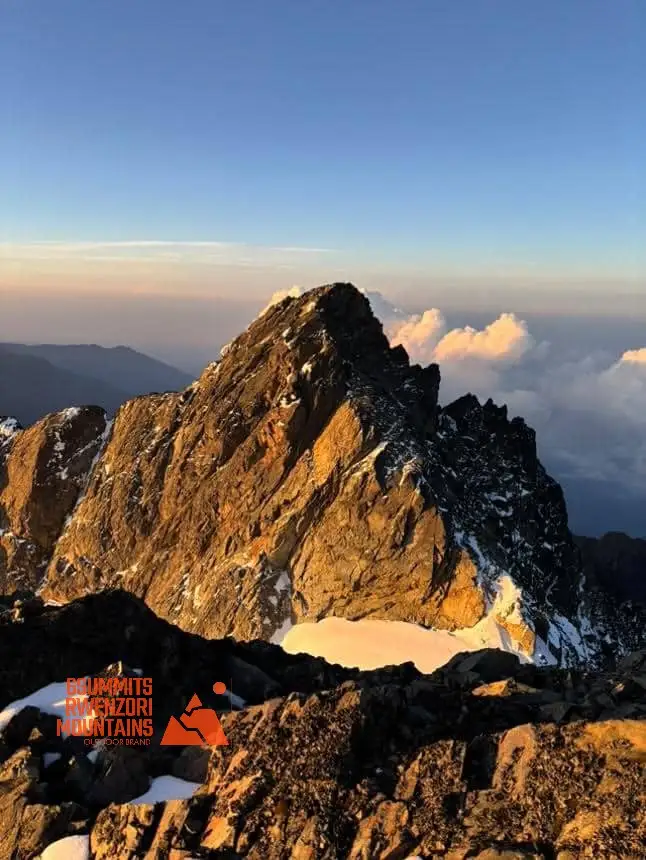
Main Rock Types
The Rwenzori Mountains contain a variety of ancient crystalline and metamorphic rocks. These rocks provide evidence of the complex geological history experienced by the region over millions and, in some cases, billions of years.
Gneiss
A strongly metamorphosed rock found widely across the mountain range.
Quartzite
A very hard metamorphic rock formed from sandstone.
Granite
A coarse grained crystalline rock occurring in parts of the range.
Schist
A layered metamorphic rock produced under conditions of heat and pressure.
Amphibolite
A metamorphic rock containing amphibole minerals.
Major Mountain Massifs
The Rwenzori range contains several major mountain groups. Mount Stanley contains Margherita Peak, the highest point of the Rwenzori Mountains, rising to approximately 5,109 metres above sea level.
Mount Stanley
Contains Margherita Peak, the highest point at 5,109m.
Mount Speke
A major glaciated massif central to the high peaks.
Mount Baker
Features striking rock walls and ancient glacial valleys.
Mount Emin
A rugged, steep peak separated from the main glaciated zones.
Mount Gessi
A dramatic, rocky peak requiring serious navigation.
Mount Luigi di Savoia
Completes the six major massifs, offering incredible views.
Tectonic Uplift and Faulting
Tectonic activity is one of the most important processes in the formation of the Rwenzori Mountains. The mountains occur within the broader East African Rift System, where the Earth’s crust is undergoing extension and deformation.
Faulting and movements of large blocks of crust contributed to the uplift of the Rwenzori. The result is a dramatic mountain landscape with:
- Very steep slopes
- Deep valleys
- High peaks
- Fault related landforms
- Strong differences in elevation over short distances
Erosion and Weathering
After the mountains were uplifted, erosion and weathering began to reshape their surface. Heavy rainfall in the Rwenzori promotes chemical weathering, while rivers and streams erode the rocks and transport sediment downslope.
At higher elevations, physical weathering becomes increasingly important. Processes such as freezing and thawing can break rocks apart, while ice and snow contribute to the modification of the mountain landscape.
Glacial Geology
One of the most distinctive geological features of the Rwenzori is the presence of glaciers at the highest elevations. The glaciers are especially remarkable because the Rwenzori lie close to the Equator. However, the glaciers have experienced substantial retreat due to changes in temperature and precipitation.
Glacial activity has shaped the landscape by:
- Carving mountain valleys
- Creating cirques
- Transporting rocks and sediment
- Forming depressions that can contain lakes
- Modifying the surfaces of high mountain peaks
Geological Importance
The geology of the Rwenzori Mountains is important because it provides evidence of ancient Precambrian geological processes, continental crustal evolution, tectonic uplift associated with the East African Rift, metamorphism, long term erosion, and glacial activity in an equatorial environment.
The combination of ancient rocks and relatively recent tectonic uplift makes the Rwenzori an important area for geological and geographical research.
The Rwenzori Mountains are primarily an ancient uplifted mountain block composed of crystalline and metamorphic rocks, rather than a volcanic mountain system. Their geological history involves ancient rock formation, metamorphism, tectonic deformation, uplift, faulting, erosion and glacial activity. The interaction between these processes has produced the dramatic landscape of the Rwenzori.